
Do the driving modes in Cadillac LYRIQ offer different ranges or battery usages?
 Sam
Sam 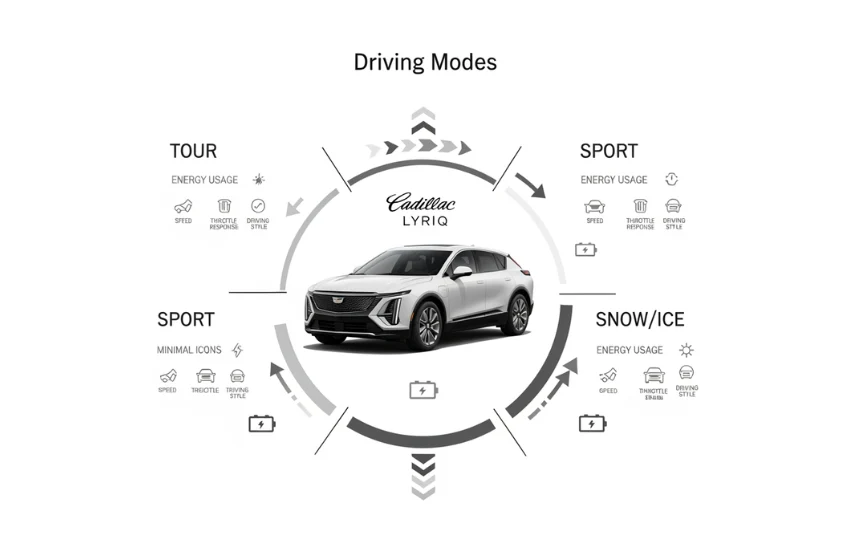
If you just got behind the wheel of a Cadillac LYRIQ or you're thinking about buying one you've probably asked yourself this exact question: Do the driving modes in a Cadillac LYRIQ actually change how far it can go? Does switching to Sport mode drain the battery faster?
Here's the short, honest answer: Yes, driving modes can affect how quickly your battery drains but they don't change the battery's actual size or capacity.
Think of it this way. Your LYRIQ's 102 kWh Ultium battery is like a full tank of gas. The driving mode is like how you press the pedal. Drive smoothly in Tour mode? You stretch every mile. Floor it in Sport mode? That "tank" empties faster. Same battery, different results.
This Research breaks down every mode, what it actually does, how it affects real-world range, and exactly when to use each one. No fluff. Just clear answers of every question in your mind.
What Is the Cadillac LYRIQ and How Do Its Driving Modes Work?
The Cadillac LYRIQ is a fully electric luxury SUV built on GM's Ultium platform. It comes in two main configurations:
- Single-motor Rear-Wheel Drive (RWD): Up to 314–326 miles of EPA-estimated range
- Dual-motor All-Wheel Drive (AWD): Up to 307–319 miles of EPA-estimated range
These EPA numbers are tested under controlled lab conditions usually in Tour Mode with climate control off. In real life, your range will vary based on how you drive, the weather, and yes, which mode you pick.
The LYRIQ's driving modes are software profiles. They don't rewire the car. Instead, they change how the car's computers deliver power, manage torque, respond to your foot on the pedal, and handle regenerative braking. Flip the mode, and the whole car's personality shifts but the battery stays exactly the same size.
All Cadillac LYRIQ Driving Modes Explained
Here's a quick-look overview before we go deep:
|
Mode |
Best For |
Range Impact |
Battery Use |
|
Tour |
Daily driving, long trips |
Best efficiency |
Lowest |
|
Sport |
Performance, fun driving |
–5% to –15% range |
Higher |
|
Snow/Ice |
Winter, slippery roads |
Slight reduction |
Moderate |
|
Off-Road (AWD only) |
Rough terrain |
Slight reduction |
Moderate |
|
My Mode |
Personalized setup |
Depends on settings |
Variable |
Now let's go mode by mode.
Tour Mode Your Best Friend for Everyday Driving
Tour Mode is the default. If you never touch the mode selector, this is what you're already in.
In Tour Mode, the LYRIQ feels calm and composed. Acceleration builds smoothly. Steering is relaxed. The car doesn't try to show off, it just drives.
What changes in Tour Mode:
- Throttle response is smooth and progressive (not jerky)
- Regenerative braking works effectively to recover energy
- Power delivery stays consistent and predictable
- Steering weight is moderate easy but not floaty
How it affects your battery and range:
Tour Mode is where you'll see numbers closest to that EPA-rated 314–326 miles. Because the pedal isn't overly reactive, you naturally drive at a steadier pace. You're not surging forward at every green light. That smoothness adds up to real miles.
Most LYRIQ owners who drive mostly in Tour Mode on mixed city and highway routes report getting close to the official EPA estimate, sometimes even slightly beating it on flat, smooth roads.
When to use Tour Mode:
- Your daily commute
- Highway trips where you want to maximize range
- Any time efficiency is the priority
- When you're not in a hurry (which, let's be honest, is most of the time)
Bottom line: Tour Mode = most miles per charge. Start here and only switch when you have a reason.
Sport Mode : More Fun, More Power, More Battery Drain
Switch to Sport Mode and the LYRIQ wakes up. The steering tightens. The throttle sharpens. Touch the accelerator and the car lunges forward immediately. It feels alive.
This is what people mean when they say the LYRIQ can genuinely surprise you for an SUV.
What changes in Sport Mode:
- Throttle mapping becomes more aggressive small pedal movement = big response
- Steering weight increases for a more connected feel
- The car responds more instantly to your inputs
- Torque delivery is front-loaded and immediate
How it affects your battery and range:
Here's the honest truth: Sport Mode will likely reduce your real-world range by 5% to 15% in typical use. On a full charge, that could mean losing 20 to 45 miles compared to Tour Mode.
Why? Two reasons:
- The car is calibrated to use more power; the motor draws higher current during each acceleration event.
- The feel makes you drive differently. When a car responds sharply to your foot, you naturally push it more. You accelerate harder, you drive faster. That's where most of the range reduction comes from not the mode itself, but your behavior in it.
If you drove at the exact same speed and acceleration in both Tour and Sport Mode, the gap would be smaller. But most people don't. Sport Mode is tempting and that's the point.
When to use Sport Mode:
- Short drives where range isn't a concern
- Highway merging or passing situations
- Spirited weekend drives on open roads
- When you want to feel what this car is actually capable of
Bottom line: Sport Mode is genuinely enjoyable. Just know it costs extra miles. Save it for when you don't need every last bit of range.
Snow/Ice Mode Safety First, Efficiency Second
When winter rolls in, Snow/Ice Mode becomes your go-to. This mode isn't about performance or efficiency, it's about keeping you safe on slippery roads.
What changes in Snow/Ice Mode:
- Torque delivery becomes much more gradual to prevent wheel spin
- Traction control systems activate earlier and more aggressively
- Stability control thresholds tighten up
- The car essentially "babysits" your acceleration to prevent slides
How it affects your battery and range:
Snow/Ice Mode has a modest effect on range in most situations. The torque softening can actually help efficiency smoother power delivery is generally more efficient. But in practice, two things push your range down in winter:
- Cold weather itself. Battery chemistry works less efficiently in the cold. You can lose 20–40% of your normal range just from temperature regardless of which mode you're in.
- Cabin heating. Using the heater in your LYRIQ is one of the biggest range drains. Always try to precondition your car while it's still plugged in before winter trips.
The mode itself doesn't dramatically drain the battery. The cold does.
When to use Snow/Ice Mode:
- Snow-covered or icy roads
- Wet, slippery pavement
- Any time you feel the rear end getting loose
- Switch back to Tour Mode once roads clear up
Bottom line: Use Snow/Ice Mode whenever conditions are slippery. Don't overthink range, your safety is worth more than a few extra miles.
Off-Road Mode (AWD Models Only) For Rough Terrain
If you have the dual-motor AWD LYRIQ, you get Off-Road Mode. This one is less talked about, but it's genuinely useful if you ever venture onto unpaved roads, gravel, or uneven terrain.
What changes in Off-Road Mode:
- Power is distributed more evenly between front and rear motors
- Traction systems are recalibrated for loose, uneven surfaces
- Throttle response is smooth to prevent wheel spin in the dirt
- Ground clearance behavior and stability are optimized
How it affects your battery and range:
Off-Road Mode has a moderate impact on range. The AWD system running both motors simultaneously uses more energy than single-motor cruising. But since you're typically going slower off-road, total consumption can vary.
When to use Off-Road Mode:
- Gravel roads or dirt tracks
- Uneven terrain or loose surfaces
- Camping or outdoor adventures
- Any situation where both axles need to work together
Bottom line: A great feature to have. Don't worry about range here if you're off-roading, you're not trying to maximize EPA numbers.
My Mode The One Most People Ignore (But Shouldn't)
My Mode is hidden away in the settings, and a lot of LYRIQ owners never touch it. That's a mistake because it's arguably the most useful mode of all.
My Mode lets you mix and match settings from the other modes. Want the sharp steering of Sport Mode but the efficient throttle of Tour Mode? Done. Want heavy regen braking but light steering? Set it up.
What you can customize in My Mode:
- Throttle sensitivity (Comfort → Standard → Sport)
- Steering weight (Light → Medium → Heavy)
- Regenerative braking intensity
- Suspension feel (on equipped trims)
How it affects your battery and range:
This completely depends on what you set it to. If you configure My Mode with a conservative throttle and strong regeneration, you can match Tour Mode efficiency or even do slightly better if you're careful. If you turn everything to maximum, you'll match Sport Mode energy use.
Pro tip: Set My Mode to Tour-level throttle with maximum regen. This is the efficiency sweet spot many LYRIQ owners swear by efficient miles with more energy recovery in stop-and-go traffic.
Bottom line: Take 5 minutes to set up My Mode. It can give you the best of every other mode combined.
How the Range Estimator Responds to Mode Changes
Here's something most articles don't explain and it confuses a lot of LYRIQ owners.
When you switch from Tour to Sport Mode, you'll often see the range number on your dashboard drop immediately even though you haven't driven a single mile.
This isn't the car losing range. It's the car predicting that you'll use more energy in Sport Mode based on your recent driving habits. The range estimator is a live calculation, not a fixed number. It constantly updates based on:
- Your current mode
- How you've been driving for the last few miles
- Temperature
- HVAC usage
- Battery state
Switch back to Tour Mode after a few calm miles, and you'll often see the number climb back up. The battery didn't change, the prediction did.
Don't stress about short-term range estimate fluctuations. Focus on your actual driving habits.
The Biggest Range Killers (Bigger Than Any Mode)
Here's the truth: your driving mode matters less than these other factors.
- Your speed Aerodynamic drag increases dramatically above 65 mph. Cruising at 80 mph can cut your range by 20–30% compared to 65 mph far more than any mode switch.
- Cold weather hits EV batteries hard. Below freezing, you can lose 20–40% of normal range. This is the number one real-world range issue LYRIQ owners face.
- Cabin heating and cooling Running the heater uses a lot of electricity more than A/C in most cases. Use the seat heaters instead of blasting hot air whenever possible. Better yet, precondition your cabin while still plugged in before you leave.
- Hard acceleration Every jackrabbit start pulls a massive surge of current from the battery. Ten smooth accelerations use dramatically less energy than ten hard launches. The mode makes you want to accelerate hard but the hard acceleration itself is what drains you.
- Tire pressure Low tires increase rolling resistance. Check pressure monthly, especially in winter when cold air causes pressure to drop.
Practical Tips to Maximize Range in Any Mode
These work no matter which mode you're using:
- Use seat heaters instead of cabin heat in winter they use a fraction of the energy
- Precondition while plugged in warm or cool the cabin before leaving so you don't drain the battery doing it
- Enable One-Pedal Driving it maximizes energy recovery on every slowdown
- Regen on Demand use the paddle behind the steering wheel to manually trigger strong regeneration when approaching stops
- Keep speeds sensible on the highway 65 mph vs 80 mph is a bigger range difference than Tour vs Sport Mode
- Anticipate stops coasting to a stop recovers energy; braking hard at the last second wastes it
- Check tire pressure monthly especially in winter
Does Driving Mode Change the Official EPA Range?
No. The EPA range number on the window sticker is a fixed figure measured under standardized lab testing. It doesn't change based on which mode you select.
What changes is your real-world range in how far you actually get on a charge in daily life. Driving modes influence that real-world number, but not the official published figure.
When comparing LYRIQ models on paper, all figures assume standard conditions typically Tour Mode with climate control set to minimal levels.
Quick Mode Decision Guide
Not sure which mode to pick right now? Use this:
Going to work or running errands? → Tour Mode
Long road trip where every mile counts? → Tour Mode (and drive at 65 mph)
Want to have fun on an open road? → Sport Mode (when range isn't a concern)
Roads are icy or wet? → Snow/Ice Mode, no question
Driving on gravel or unpaved roads? (AWD) → Off-Road Mode
Want a custom setup for your style? → My Mode (set it once, use it always)
Final Verdict: Do the Driving Modes in Cadillac LYRIQ Offer Different Ranges or Battery Usages?
Yes but the battery never changes. What changes is how energy flows out of it, and how each mode influences the way you drive.
Tour Mode gives you the most miles. Sport Mode gives you the most fun. Snow/Ice keeps you safe when roads get nasty. My Mode lets you build your perfect setup.
But honestly? The biggest range factor isn't the mode it's you. Smooth driving beats any setting every time.
Pick the right mode for the moment, drive with awareness, and the LYRIQ will rarely let you down. For more tips and updates must visit Mindsflip.
Same battery. Smarter driving. Better range.