
 David
David 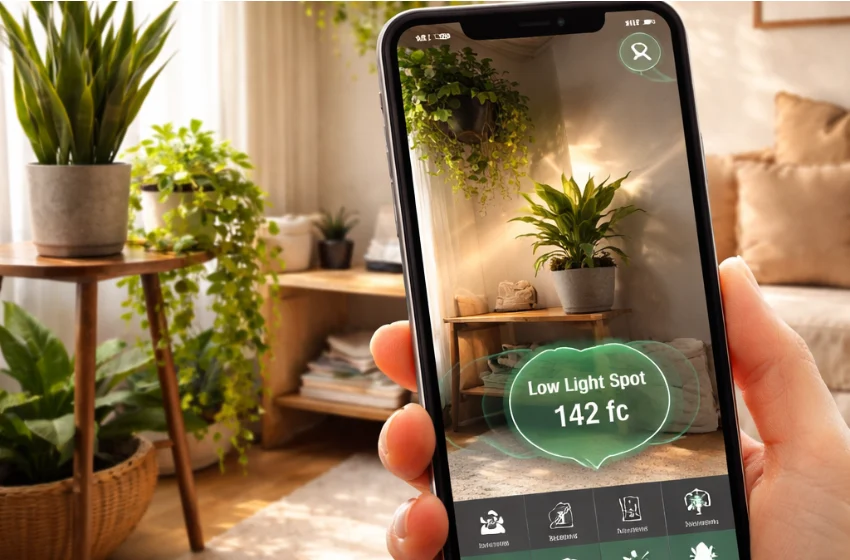
There’s one dark corner in everyone’s home that craves plants. But if you guess which plants will survive in such a spot, the result is often wilted leaves and wasted money. Luckily, technology has come to the rescue, helping streamline indoor gardening. We can use plant augmented reality apps on your smartphone to measure precise light levels in any room before introducing a new leafy companion to your home.
Here, we explained exactly how to use these tools so that you don’t have to learn by trial and error.
Understanding Low-Light Conditions: Beyond the Obvious
They say low light means no light. To find the right one, you need to know what your plant specifically needs for survival.
Defining "Low Light" and Photosynthesis Basics
For most houseplants, “low light” is defined as 50 to 250 foot-candles of brightness. This is the minimum threshold for driving photosynthesis in plants. Photosynthetic plants are appropriate, relying on a certain spectrum and proper light intensity to convert water and carbon dioxide into food. Without it, growth stalls entirely.
Common Mistakes in Assessing Spots
Our eyes are trained to adapt well in low-light conditions. What you see as a bright, cozy corner may be pitch black to a pothos. Trusting your eyes rather than a measurable unit usually ends with wilted, yellow leaves and eventual staggers toward plant oblivion.
How AR Technology Revolutionizes Plant Placement
This takes all the guesswork out of where to place a plant, as augmented reality essentially turns your phone into a very accurate light meter.
The Mechanics of Plant AR Apps
AR apps use your phone's camera and ambient light sensors to navigate a room. They analyze incoming light data and let you position virtual plants around your space. This allows you to visually and data-metrically confirm that the environment meets a particular plant’s needs before you ever purchase it.
Step-by-Step Guide: Using AR to Evaluate Your Space
We make finding the right spot easy. Just follow these steps:
- Get a plant AR app: Make sure it has light metering capabilities (like Photone).
- Scan your surroundings: Identify the spot where you want to place the plant, and hold your phone there (camera facing light source).
- Analyze the reading: Look at the foot-candle or PAR (photosynthetically active radiation) readings and determine whether they fall within the range your plant needs.
Advanced AR Features for the Serious Plant Enthusiast
You could take a broader look at your environment using ARK augmented reality frameworks, where data is organically mapped to the environment in real time. These smart tools provide historical light-tracking and growth-modeling predictions. They track the sun’s trajectory across your living room throughout the year and provide personalized plant recommendations based on real data.
Data-Driven Plant Care: AR Success Rates
Reducing mortality rates by displaying plants through AR. Though over- and underwatering are responsible for a great deal of plant deaths, weak plants from poor lighting can become susceptible to both root rot and pests.
Plant Health Improvement with AR
|
Metric |
Traditional Placement |
AR-Assisted Placement |
|
Average Light (Foot-Candles) |
40 (Too low) |
150+ (Ideal) |
|
Growth Rate |
Stunted |
Normal to Robust |
|
Leaf Drop |
High |
Low |
User Satisfaction and Plant Longevity
|
Measurement |
Traditional Placement |
AR-Assisted Placement |
|
1-Year Survival Rate |
45% |
85% |
|
User Confidence |
3/10 |
9/10 |
Choosing the Right Low-Light Plants with AR Guidance
Once you map your low-light spots, match them with hardy, shade-tolerant plants.
Top 5 Low-Light Thriving Houseplants
- ZZ Plant: Hearty, low-maintenance, and tolerant of very low light.
- Snake Plant: Extremely adaptable and almost indestructible.
- Pothos: Trailing; loves indirect, dimmer light.
- Cast Iron Plant: True to its name, it thrives in tough conditions.
- Parlor Palm: Gives a tropical vibe to darker spaces.
Cultivating a Greener Future with Technology
Technology makes plant care simpler. With AR measuring the light, you're putting your indoor garden in great hands. Our tools do the heavy lifting, so you know exactly what to avoid. Take out your phone, chart your space, and start growing confidently now. For more exciting news must visit Mindslfip.
FAQs
Is Plant AR accurate for all light conditions?
Yes, most modern smartphone cameras and AR apps can accurately measure lux and foot-candles for average houseplant needs.
What are the best AR apps for plant placement?
Photone and a handful of ARKit-based plant placement simulators dominate the field for their accuracy and intuitiveness.
Can AR really help my struggling plants?
Absolutely. I also help find the exact right light level, which prevents stress and helps your plant use its energy to recover.
How often should I re-evaluate my plant's light with AR?
Check once a season. The angle of the sun varies throughout the year, and this has a dramatic effect on how much light reaches your indoor spaces.
Is ARK augmented reality available on all devices?
The operating systems of most modern iOS and Android smartphones already include ARKit and ARCore, so these tools are widely accessible.