

Idaho Policy Institute Formal Eviction Rate 2020: What Shoshone County's Numbers Really Tell Us
 Jack
Jack 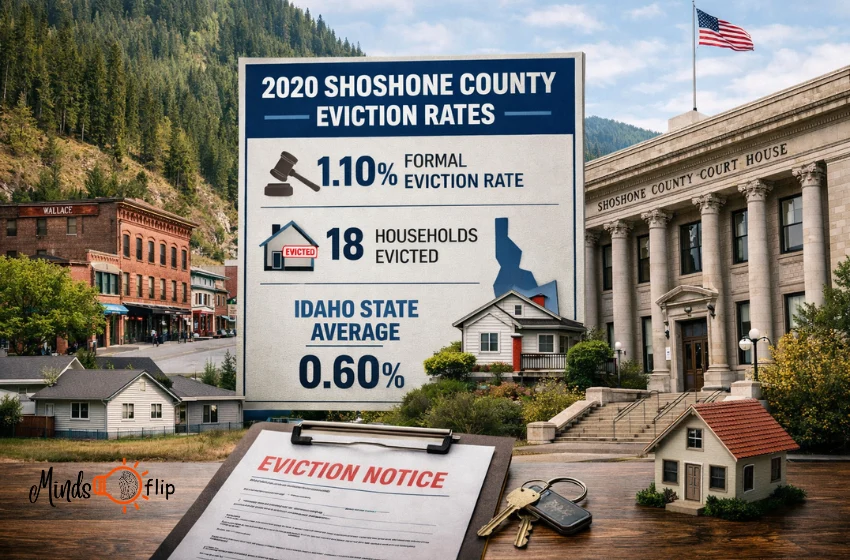
If you've been searching for the Idaho Policy Institute formal eviction rate 2020 Shoshone County data, you're probably looking for more than just a number. You want to know what it means for families, for landlords, and for a small Idaho community that rarely makes the news.
Here's the short version: In 2020, about 1 in every 90 renter households in Shoshone County was formally evicted by a court order. That's nearly double Idaho's statewide average of 0.6%.
In a county of roughly 13,500 people, those numbers are small in volume but large in impact. One eviction in a tight-knit town like Wallace or Kellogg doesn't just remove a person from a home it reshapes a community.
This article breaks down the data clearly, explains what a "formal eviction" actually means, and puts Shoshone County's numbers in context. No jargon, no guesswork.
What is the idaho policy institute formal eviction rate 2020 shoshone county?
idaho policy institute formal eviction rate 2020 shoshone county (IPI) is a public policy research center at Boise State University. It tracks housing data, specifically eviction filings and formal eviction orders by pulling case records directly from Idaho's court system.
This is important because IPI doesn't estimate or survey. It reads actual court records across all 44 Idaho counties. That makes the data reliable and consistent year over year.
Think of IPI as Idaho's housing data watchdog. Its job is to count what courts officially document, not what happens behind closed doors before anyone files a case.
What Does "Formal Eviction Rate" Actually Mean?
There are two terms worth knowing: eviction filing and formal eviction.
A filing is when a landlord takes a tenant to court. A formal eviction is when a judge rules in the landlord's favor and issues a legal order for the tenant to leave. Not every filing becomes a formal eviction but every formal eviction starts with a filing.
The formal eviction rate is the percentage of renter households in a given county that received a court-ordered removal in a given year. It's calculated by dividing the number of formal eviction orders by the total estimated number of renter households.
Why does the distinction matter? Because many tenants leave before a hearing. Some pay back rent. Some reach a private agreement with their landlord. Those cases never become formal evictions, and they don't appear in IPI's data. So the formal eviction rate only captures the hardest-hit cases, the ones where the system ran its full course.
See Also : Engineering Firms Business Classification Criteria in the USA Everything That Actually Matters
The 2020 Numbers for Shoshone County
Here's what the Idaho Policy Institute data shows for Shoshone County in 2020:
| Metric | Shoshone County (2020) |
| Formal Eviction Rate | 1.10% |
| Idaho Statewide Average | 0.60% |
| Total Renter Households | 1,642 |
| Households Formally Evicted | 18 |
| Eviction Filing Rate | 1.89% |
| Total Filings in 2020 | 31 |
| Filings Resulting in Formal Eviction | 58% |
| Odds for a Renter | 1 in 90 |
Sources: Idaho Policy Institute, Boise State University; Idaho Supreme Court Records, 2020.
On the surface, 18 households sounds small. But look at it this way: Shoshone County has fewer than 1,700 renter households. Every eviction here is roughly 1/90th of the entire rental community. In New York City, that same percentage would represent tens of thousands of people.
Scale matters. Shoshone's numbers hit harder because there's less to absorb the blow.
Why Was Shoshone County's Rate Higher Than the Statewide Average?
This is the real question and the answer sits in the county's economic DNA.
Shoshone County sits in Idaho's Silver Valley, historically built on mining and forestry. Those industries have shaped local income levels, employment stability, and housing stock for generations. By 2020, seasonal work, small business employment, and tourism had joined the mix and every one of those sectors got hit hard by the pandemic.
Job losses in early 2020 were swift. Hours were cut. Small businesses shuttered. When income drops overnight and rent doesn't, the math gets brutal fast.
On top of that, Shoshone faced a structural gap that rural counties often share:
- Fewer nonprofit housing agencies operating locally
- Limited legal aid options for tenants facing eviction
- No formal mediation programs between landlords and renters
- Small landlord pool with tight financial margins meaning unresolved rent issues escalated quickly
Unlike Ada or Canyon County, Idaho's most populated counties, Shoshone had fewer safety nets to slow the path from filing to formal eviction. Once a landlord filed, the case often went all the way.
Dr. Katherine Nelson, a housing policy researcher at Boise State University, has noted that formal eviction numbers show where the legal system intervenes, not where housing instability begins. That's a key distinction for rural counties where the instability often precedes the paperwork.
The Role of COVID-19 and Federal Protections
In 2020, the U.S. government put federal eviction moratoriums in place. Courts temporarily closed or slowed their operations. Emergency rental assistance programs launched. On paper, 2020 should have been a relatively safe year for renters.
And statewide, it mostly was. Across Idaho, eviction filings and formal evictions dropped roughly 30% compared to 2019. The statewide formal eviction rate of 0.6% was lower than most pre-pandemic years.
But those protections didn't reach everyone equally. In rural counties like Shoshone, information about available resources traveled slower. Applications for rental assistance required internet access, documentation, and time — things that struggling families often don't have in abundance. Some tenants didn't even know the moratoriums applied to them.
The result: even in a year when the system tried to pause evictions, Shoshone County's rate still came in nearly double the state average.
See Also : Sovereign Foods Quality Control Job Matric Pass Fail Requirements Explained
What Does a Formal Eviction Actually Do to a Person?
It's easy to read a percentage and miss the person behind it. A formal eviction is not just a bad day, it follows people for years.
Once a court issues a formal eviction order, it becomes part of the public record. Future landlords can see it. Background check companies flag it. Getting approved for a new rental becomes significantly harder, especially in a county where rental options are already scarce.
The ripple effects go further:
- Children may need to change schools mid-year
- Families often move in with relatives, straining other households
- Credit scores can take a hit if unpaid rent is sent to collections
- Emergency shelter use goes up, straining already thin local resources
- Local businesses lose spending when households are displaced
In Shoshone County, where social networks are tight and rental housing options are limited, even 18 evictions can send shockwaves through a community. Think of it like removing a few stones from a small arch bridge each one carries more weight than it looks.
What the Data Doesn't Show
Here's something worth sitting with: the formal eviction rate only counts cases that went through the courts.
Many more renters likely left without a formal filing. Some got a notice and moved out before the hearing. Others faced pressure locked out, utilities cut, harassment — and left without any legal process at all. Those situations are what housing advocates call "informal displacement," and they're invisible in IPI's data.
Housing advocate Laura Hines of Idaho Voices for Children has argued that rural eviction is a story of invisibility. Without strong county-level data publication, the real scale of housing instability in places like Shoshone goes undercounted.
So when you read 1.10%, know that it's a floor, not a ceiling. The true number of families who lost stable housing in 2020 is almost certainly higher.
What Can Be Done? A Look at Practical Solutions
Shoshone County's 2020 data doesn't have to be a fixed story. It's a starting point for better decisions.
Several targeted changes could reduce formal eviction rates in rural Idaho counties:
- Expand local rental assistance programs that don't require complex applications or extensive documentation
- Fund legal aid outreach specifically for rural counties so renters know their rights before a filing happens
- Create landlord-tenant mediation resources at the county level to catch disputes before they reach a judge
- Improve housing stock by incentivizing new affordable rental construction in Silver Valley communities
- Use IPI data actively local leaders and community organizations should review county-level numbers annually
None of these are quick fixes. But the data from IPI gives policymakers and community leaders a specific, evidence-based place to start instead of guessing.
Why Does This Data Still Matter in 2026?
The 2020 data is six years old, but its lessons are still relevant. Idaho's rental market has tightened since then. Rents have gone up. The post-pandemic economy reshuffled who works where and for how much. The structural vulnerabilities in rural counties like Shoshone haven't disappeared.
IPI continues to track eviction data year by year. Comparing 2020 to current numbers shows whether rural housing has stabilized or slipped further. For anyone working in housing, policy, or community organizing in northern Idaho, that trend line is one of the most important numbers to watch.
The 2020 snapshot was a warning sign. Whether Idaho acted on it is the more important question today.
Final Thoughts
The Idaho Policy Institute formal eviction rate 2020 Shoshone County figure 1.10% tells a bigger story than its small size suggests.
It tells us that rural renters face a different set of risks than urban ones. Fewer resources, less visibility, and less political weight. When the system fails them, it fails quietly.
Data like IPI's is exactly the tool needed to make those quiet failures visible. The job now is to use it. For more accurate and real insight about Global happenings must follow Mindsflip.