
Oil Palm Waste Used Lamp Project: Does It Exist, How It Works & Real-World Impact
 Sara
Sara 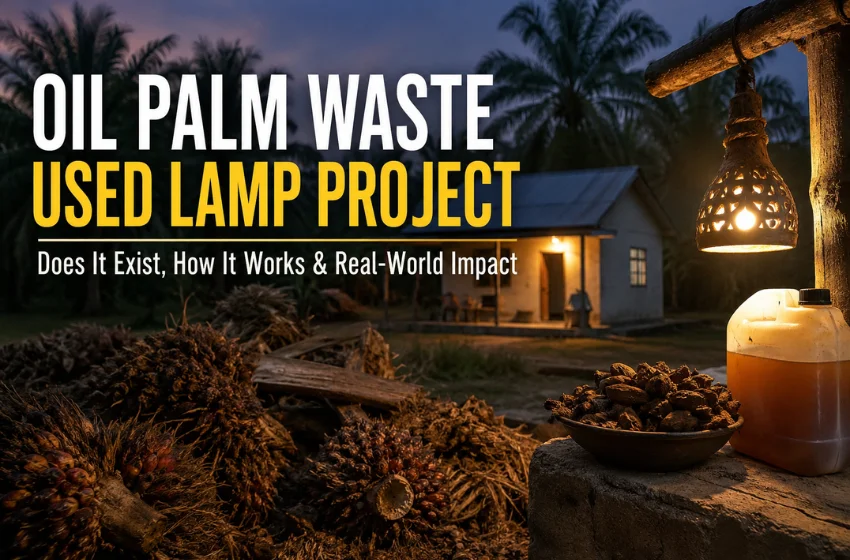
Yes it's real, it's deployed, and it's further along than most people know.
The oil palm waste used lamp project isn't one single initiative. It's a category of projects across Malaysia, Indonesia, Nigeria, and beyond that take the enormous waste stream from oil palm processing and turn it into functional lighting for communities that need it most.
Here's the full picture: the waste types involved, the technologies that convert them into light, the real-world deployments that prove it works, and what makes this different from a science fair concept.
The Problem This Project Solves
Oil palm is one of the world's most productive crops and one of its most wasteful industries. For every tonne of crude palm oil produced, the mill generates roughly 1.1 tonnes of solid waste and significant volumes of liquid effluent.
The main waste streams include:
- Empty Fruit Bunches (EFB) the fibrous clusters left after palm fruits are stripped
- Palm Kernel Shells (PKS) the hard shells surrounding palm kernels after oil extraction
- Palm Oil Mill Effluent (POME) the liquid waste from processing, rich in biogas potential
- Palm Fronds and Fibers pruned during harvesting and processing
Traditionally, most of this waste is open-burned, landfilled, or left to decompose releasing methane and carbon emissions into the atmosphere. In rural palm-growing regions, communities simultaneously suffer from inadequate lighting, relying on kerosene lamps that are expensive, polluting, and hazardous.
The oil palm waste lamp project closes both gaps at once: it eliminates a waste problem while creating an energy resource.
Two Distinct Approaches: How Palm Waste Becomes Light
There are two fundamentally different ways the project works, and understanding both matters.
Approach 1: Biomass Energy → Electricity → LED Lamps
This is the energy generation pathway. Palm waste, primarily EFB and PKS, is converted into electricity through biomass processing, which then powers LED street lamps and household lights.
The conversion process:
Step 1 Drying: Fresh EFB arrives wet from harvest. The primary challenge for biomass projects involves feedstock moisture content, as empty fruit bunches arrive very wet and require proper drying before gasification to avoid heavy smoke and poor energy production. Sun drying or mechanical drying reduces moisture to workable levels.
Step 2 Gasification or Combustion: Dried biomass is fed into a gasifier (which converts solid biomass into combustible syngas) or a direct combustion boiler. PKS has particularly high energy density analysis from Aceh Province, Indonesia showing that OPF-PKS mixed biomass can produce 106.15 MW of power when properly processed at scale.
Step 3 Power Generation: The syngas or steam drives a generator, producing electricity.
Step 4 LED Lighting: The electricity powers efficient LED lamps, street lights, home lighting systems, or community micro-grid connections. A standard 100 kW micro-grid powered by palm waste can support approximately 200 high-intensity street lamps and provide basic evening power for 50–70 rural homes.
Approach 2: Palm Waste as Lamp Structure and Fuel
This is the craft/design pathway transforming palm shells and fibers into the physical body of decorative and functional lamps, with palm oil itself serving as the fuel source.
Palm kernel shells dense, hard, and naturally textured serve as decorative outer housing. Palm fibers provide structural framing. Residual palm oil or bio-oil extracted from EFB through pyrolysis serves as the burning fuel for oil lamps.
This approach is lower-tech but highly accessible. It requires no grid infrastructure, no industrial equipment, and can be implemented at household or community level with minimal training. It also has deep historical roots; the concept of palm oil-powered lighting dates back centuries to the Kingdom of Benin in present-day Nigeria, where large metal lamps filled with palm oil and cotton wicks provided organized street lighting long before European cities had comparable systems.
Real Projects That Exist Right Now
This is not theoretical. Here are documented deployments:
FGV Malaysia Industrial Scale Biomass Power
FGV's renewable portfolio delivers a total energy output equivalent to around 150MW, comprising 100MW from biogas and biomass electricity generation and 50MW from biofuel equivalent through Palm Kernel Shell utilization. Their flagship Triang Biogas Plant in Pahang exports 2MW to the national grid, powering approximately 15,000 homes. The Umas Plant in Tawau provides rural electrification directly to underserved communities. The philosophy driving the entire initiative is simple but powerful: "Nothing goes to waste, everything generates value."
Global Peace Foundation Malaysia Off-Grid Village Lighting
In March 2025, Global Peace Foundation Malaysia successfully illuminated three additional off-grid kampungs Kampung Sagong, Kampung Tenlan, and Kampung Semul in Kuala Lipis, Pahang benefiting 493 families across Peninsular Malaysia. Technical Manager Arok Hanong, from the Temuan tribe, leads installation and training for these communities. The project follows a comprehensive eight-step engagement process including community consultation, Free Prior and Informed Consent (FPIC), maintenance fund establishment, and mentor-based installation training, a model that treats communities as partners, not recipients.
BOSUN Lighting Nigeria
BOSUN Lighting completed a landmark solar street light project in Port Harcourt, Nigeria one of Africa's largest oil palm-producing cities addressing the unique environmental challenges of palm oil regions. The project demonstrates how palm-region infrastructure can be designed specifically for the environmental conditions (dust, humidity, organic debris) that palm cultivation creates.
ScienceDirect Feasibility Study Sarawak, Malaysia
Research published in ScienceDirect examines the cost-effective comparison between electricity generated from palm oil waste and standalone diesel electric generation in Marudi, Sarawak, Malaysia investigating the potential electricity generation using palm oil waste and the feasibility of implementing the technology in rural areas. The findings support palm waste biomass as a cost-competitive alternative to diesel generation in remote palm-growing communities.
How to Build a Basic Oil Palm Waste Lamp (Step-by-Step)
For students, educators, and community makers here is the practical construction pathway for a simple decorative/functional palm waste lamp.
Materials needed:
- Palm kernel shells (cleaned and dried)
- Palm fiber or frond strips
- Residual palm oil or bio-oil
- Cotton wick
- Wire frame or metal base
- Sandpaper, adhesive, basic tools
Step 1 Collect and clean materials Gather palm kernel shells and fibers. Wash thoroughly to remove mill residue and dirt. Dry completely under sunlight moisture causes smoking and weak combustion.
Step 2 Design the lamp structure Sketch your design before cutting. Palm shells work well as decorative outer panels or as a curved housing. Fibers can be woven into a frame. Decide whether the lamp will be freestanding, wall-mounted, or hanging.
Step 3 Shape and assemble Cut shells to desired shapes using a saw or strong blade. Smooth rough edges with sandpaper critical for handling safety. Assemble the housing using adhesive or mechanical joints, allowing full cure time.
Step 4 Install the fuel system For an oil lamp design: fit a small metal reservoir inside the housing, fill with palm oil, and thread a cotton wick through a metal holder. For an electric design: install a low-voltage LED bulb connected to a small battery or solar panel.
Step 5 Test and seal Test the lamp before final sealing. For oil lamps, verify the wick draws fuel correctly. For electric lamps, confirm all connections are secure. Apply a protective sealant to the shell exterior to prevent moisture absorption.
Comparison: Palm Waste Lamp vs. Other Off-Grid Lighting Options
In 2026, the oil palm lamp project competes alongside dominant solar technologies and solar-hybrid mini-grids, particularly relevant for rural palm-growing regions like Sabah (Malaysia) and Kalimantan/Sumatra (Indonesia), where local waste abundance gives biomass an edge in certain niches.
|
Feature |
Palm Waste Biomass Lamp |
Solar Home System |
Kerosene Lamp |
Solar Mini-Grid |
|
Fuel source |
Local agricultural waste |
Sunlight |
Imported fossil fuel |
Sunlight |
|
Weather dependence |
None dispatchable anytime |
High no sun, no power |
None |
Moderate (battery backup) |
|
Startup cost |
Low–Medium |
Low–Medium |
Very low |
High |
|
Ongoing fuel cost |
Near zero (waste is free) |
Zero |
High and recurring |
Zero |
|
Carbon emissions |
Low (waste-based) |
Zero |
High |
Zero |
|
Rural accessibility |
Excellent in palm regions |
Universal |
Universal |
Requires infrastructure |
|
Community employment |
Yes local collection/processing |
Minimal |
None |
Some |
The key advantage biomass has over solar: dispatchability. Unlike intermittent solar power, biomass energy can be burned whenever light is needed regardless of weather conditions. In regions with heavy cloud cover or rainy seasons, this is operationally significant.
Environmental and Social Impact
The environmental case is strong but it comes with honest nuance.
Positive impacts:
- Eliminates methane emissions from decomposing EFB (methane is 25x more potent than CO₂ as a greenhouse gas)
- Replaces kerosene lighting, removing indoor air pollution that causes significant respiratory disease in rural households
- Creates circular economy value from materials that previously had none
- Carbon credit monetization offers strong upside Malaysia advances frameworks for palm waste projects to earn credits via reduced methane from avoided decomposition, tradable on platforms like Bursa Carbon Exchange.
Honest challenges:
- PKS already has commercial market value sold to cement and steel industries meaning lamp projects compete with established commodity buyers for feedstock
- EFB moisture content requires drying infrastructure that adds cost and complexity
- Engineering refinements have played a crucial role in making these systems viable early-stage projects face technical barriers that require skilled implementation
Social impact:
- Extended hours for study, work, and community activity in off-grid villages
- Reduced household expenditure on kerosene (which can consume 10–30% of rural household income in palm regions)
- Local employment in waste collection, processing, and system maintenance
- Energy independence from centralized grid infrastructure
Myth vs. Fact
|
Myth |
Fact |
|
"This is just a student project concept" |
Industrial-scale deployments exist FGV Malaysia operates 150MW of palm waste energy capacity |
|
"Palm oil lamps are primitive technology" |
The concept dates to ancient Benin City's organized street lighting modern projects use LED systems powered by biomass gasification |
|
"Solar is always better than biomass" |
Biomass is dispatchable regardless of weather complementary to solar, not inferior to it |
|
"Palm waste is too wet to use as fuel" |
Correct drying protocol solves this it's an engineering step, not a fundamental barrier |
|
"This only works in Malaysia" |
Active projects exist in Indonesia, Nigeria, and across West Africa's palm-growing belt |
Frequently Asked Questions
What is the oil palm waste used lamp project? It's a category of initiatives that convert oil palm agricultural waste primarily empty fruit bunches, palm kernel shells, and palm fibers into functional lighting systems. Projects range from decorative handcrafted oil lamps made from palm shells to industrial biomass power plants that generate electricity for LED street lighting in rural communities.
How does oil palm waste generate electricity for lamps? Palm waste biomass is dried then fed into a gasifier or combustion boiler, which drives a generator to produce electricity. That electricity powers LED lamps. A 100 kW palm waste micro-grid can support approximately 200 street lamps and provide basic evening lighting for 50–70 rural homes.
Where is the oil palm waste lamp project currently active? Active projects exist in Malaysia (FGV's industrial biomass plants, Global Peace Foundation off-grid village projects), Indonesia (biomass power research in Aceh and Kalimantan), and Nigeria (BOSUN Lighting solar-biomass projects in Port Harcourt). Academic feasibility studies have been conducted for Sarawak, Malaysia.
Can I build an oil palm waste lamp at home or for a school project? Yes. Palm kernel shells and fibers can be assembled into decorative lamp housing using basic tools. A simple oil lamp version uses palm oil as fuel with a cotton wick. A more advanced version integrates a small LED bulb connected to a battery. The step-by-step construction process above covers both approaches.
Is palm waste biomass better than solar for rural lighting? They serve different conditions. Solar is simpler and zero-emission but depends on sunlight. Palm waste biomass is dispatchable; it works at night, in rain, in heavy cloud and uses locally abundant waste. In palm-growing regions with seasonal cloud cover, biomass provides energy security that solar alone cannot.
The Bottom Line
The oil palm waste used lamp project is real, it works, and it is already improving lives in off-grid communities across Southeast Asia and West Africa.
It operates on a principle that is both simple and genuinely powerful: a waste product that causes pollution when left to decompose becomes a community asset when directed through the right conversion technology. Empty fruit bunches that would otherwise release methane into the atmosphere instead power LED street lights in villages that previously relied on kerosene. For more latest updates must visit Mindsflip.
By channeling palm oil by-products into lighting applications, the project reduces the need for open burning or uncontrolled disposal of organic waste, lowering local air pollution and mitigating greenhouse gas emissions associated with waste decomposition.
Whether you're researching this as a student project, evaluating it as a development practitioner, or exploring it as an investment opportunity the technical foundation is proven, the deployments are documented, and the demand from underserved communities is real.