

The Concurrent Audit Problem: Managing Three RADV Cycles at Once Without Breaking Your Team
 David
David 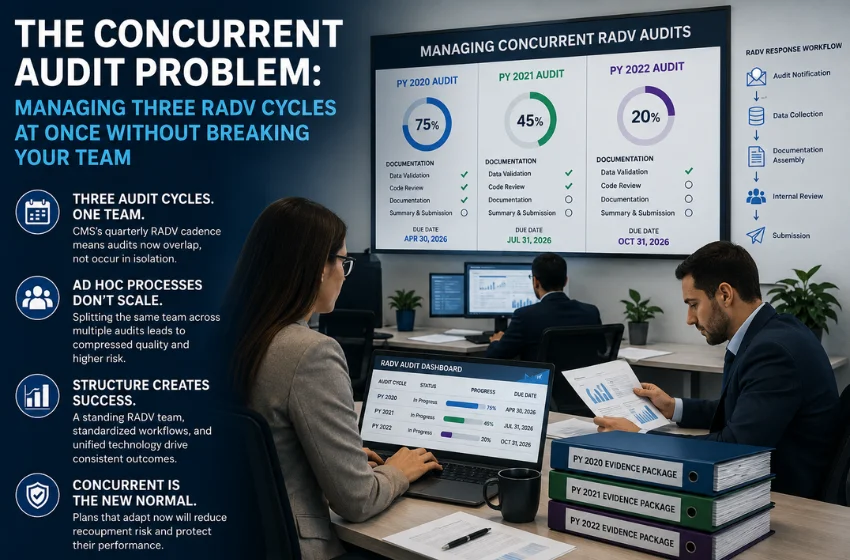
When One Audit Was Enough to Handle
Before 2025, most health plans experienced RADV audits as isolated events. A notification arrived. A team mobilized. The response consumed weeks of focused effort. The audit closed. The team stood down. There might be years before the next one. Each audit was a project with a beginning, middle, and end.
CMS's shift to quarterly cadence changed the math. A plan responding to its PY 2020 audit in Q1 2026 could receive a PY 2021 notification in Q2 while the first cycle is still active. By Q3, a third cycle could begin. Each cycle has its own enrollee sample, its own documentation requirements, its own submission deadline, and its own findings to review and rebut. The audit function doesn't pause between cycles. It stacks.
Why Concurrent Audits Break Ad Hoc Processes
Ad hoc audit response relies on the same people doing the same intensive work each time. The coding director pulls in senior coders. The compliance officer coordinates with legal. An analyst assembles documentation packages. This works for one audit because the team focuses exclusively on it.
When three audits run simultaneously, the same team splits across three parallel workstreams. The coding director can't dedicate full attention to any single cycle. The analyst assembles packages for three different enrollee samples against three different deadlines. Quality review, the step most likely to be compressed under time pressure, gets compressed three times over.
The failure mode isn't incompetence. It's capacity. The team that handled one audit well doesn't have three times the capacity. Without structural changes, concurrent audits produce lower-quality responses across all active cycles rather than high-quality responses for one. Lower-quality responses produce more discrepant findings. More findings produce larger recoupment exposure.
Structuring for Concurrent Cycles
The solution is converting audit response from a project into a standing function with dedicated resources. A permanent RADV response team, separate from day-to-day coding operations, manages all active audit cycles in parallel. The team maintains a unified dashboard showing every active audit's status, deadlines, and progress. Workflows are templated so that each new cycle follows the same documented process without requiring reinvention.
Technology consolidation is the enabling factor. When all evidence trails, coding decisions, and documentation live in a single system, the RADV team queries one environment for all active audits. There's no separate data assembly for each cycle. A member's evidence package, built during the original coding process, serves any audit that samples that member regardless of which cycle it falls in.
Staffing models should account for peak concurrent load. If the plan anticipates managing three simultaneous cycles, the team needs capacity for three. Hiring to handle one and hoping the others don't overlap is the same planning failure that made ad hoc response insufficient in the first place.
The New Operational Reality
Concurrentradv audits are the new normal, not an exceptional circumstance. Plans that restructure their audit response function for sustained parallel operations will produce consistent evidence quality across all active cycles. Plans that keep running ad hoc response processes will watch their quality degrade as each additional concurrent cycle dilutes the team's capacity. The difference in outcomes compounds with every overlapping audit. For more updates visit Mindsflip.